Scale by Geoffrey West


You need to look hard these days for a politician whose campaign doesn’t rely on infinite growth, or a tech CEO who doesn’t claim to have invented a perpetual motion machine. Physics – specifically the laws of thermodynamics – rarely enters the debate. Yet entropy represents an uncomfortable truth: many physical processes can only go in one direction. Nothing lasts for ever. And the faster we consume resources, the faster we approach their inevitable limits.
As humans, our basic daily metabolic needs are modest – around 2,000 calories, equivalent to a 90-watt lightbulb over the same period. But if you include all the other modern-day "essentials", such as heating, lighting, transportation, computers, and air conditioning, it jumps to 11,000 watts: enough to sustain twelve elephants. Given the rapid growth in the global population and our clamour for energy-hungry devices, that's a lot more metaphorical elephants rampaging around.
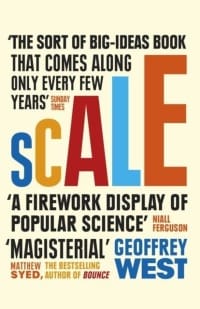
In Scale (2018), theoretical physicist Geoffrey West explores how mathematical principles govern metabolism and growth across organisms, cities, and corporations. Through a range of mathematical models, he demonstrates how similar scaling laws apply whether we’re examining big mammals or big companies. These universal patterns not only help explain our own mortality but can also be used to predict the life cycles of the companies we depend upon. By understanding these fundamental metabolic processes, can we better navigate the inevitable constraints of both biological and economic systems?
The book blends lucid scientific explanations with engaging personal reflections. After decades immersed the physical sciences, West found himself – like many of us – contemplating mortality in his fifties. This introspection prompted him to consider the intersection between physics and biology, and ultimately to address significant gaps in economics and social theory. As West points out, "Remarkably, concepts like energy and entropy, metabolism … have not found their way into mainstream economics," (p. 238) despite all economic activity ultimately relying on finite natural resources. The scope of the book is ambitious, but West is motivated by curiosity, rather than hubris. He is a likeable and humble guide.
West’s work spans a range of complex systems, with insights focused on four interconnected domains: technological innovation, human mortality, urban development, and corporate lifecycles. While he doesn’t explicitly address financial markets, his framework of scaling laws can also help us understand the current market volatility.
The Perpetual Motion Machine
Although generative AI was in its infancy when West wrote this book in the 2010s, his broader analysis of the tech sector illuminates our current predicament. To sustain its metabolic needs, argues West, capitalism is reliant on achieving another huge breakthrough. When a system grows faster than exponentially (superlinearly), it inevitably reaches a point where its demand for resources, energy, or innovation become infinite. Since we don’t have infinite resources, the system must either collapse or undergo a fundamental paradigm shift. Paradigm shifts such as the steam engine, electricity, and the World Wide Web have effectively reset the clock by providing new resources of efficiencies. Due to the appetite for fast growth, these innovations must occur at increasingly shorter intervals. Innovation cycles have compressed from thousands of years (Stone Age to Bronze Age) to mere decades (Computer Age to Digital Age). Now it feels as though that cycle is breakfast to dinner.
This mathematical reality explains that only an innovation of the magnitude of the World Wide Web can save us by stimulating enough revenue-generating products and efficiencies. This explains all the hype and investment around AI, as corporations and governments are desperate for this technology to revolutionise everything. While some AI-based tools present genuine advances, others aren’t worth the resources, especially when they’re being diverted from nearby communities. As West points out, all ideas – even the unsuccessful ones – use energy: "There is always a price to pay when energy is processed: there is no free lunch ... unusable products are inevitable. ... There are no perpetual motion machines." (p.14)
And it’s not just natural resources that are needed. As we’ve seen in recent court cases, tech companies need bushels of content to fuel their Large Language Models. Those ravenous LLMs metabolise books, blog posts, and journalism at a prodigious rate, much faster than anyone can hope to replenish them. Even if the CEOs succeed in seizing all our IP, it won’t sustain them for long. I suspect they have no idea how long it takes to write a good book or a thoughtful blog post. Neither do they grasp how their actions disincentivise content creators. Why would we spend years labouring over a book that’s immediately gobbled up and regurgitated by a chatbot? Tech bros dismiss and devalue our work, but can’t survive without it.
Should we commit a growing percentage of the world’s dwindling natural resources in pursuit of a “revolution” that can’t deliver on its promises? Do we endure energy rationing to ensure AI companies can keep growing? This feels like a throwback to energy allocation in earlier times, when women and children were expected to go without food so the male breadwinner had enough fuel to work. At least in that unsatisfactory situation, the man was actually earning money. Most AI companies are losing money. If they really have created a perpetual content machine, do we all get to share in the bounty? Given governments’ squeamishness around taxing big companies, it’s unclear how the benefits would be shared. Liabilities are collectivised, but profits are privatised.
This is not to suggest that we should abandon AI. Rather that we heed the constraints of thermodynamics and consider whether the tech companies can fulfil their promise, especially when they’re relying on currently insoluble paradigm shifts such as nuclear fusion. If not, a more balanced approach is required, with proper governance of those companies and transparency around the cost to all of us. Given the potential for waste, we also need to avoid innovation for innovation’s sake. Someone who’s sitting quietly with a book is doing far less harm than someone who is vigorously “innovating” with unnecessary AI tools. But there are few economic incentives for reading. Our economic systems are currently predicated on superlinear scaling and unbounded growth, meaning we’ll deplete our finite resources much faster. We need to distinguish between innovations that genuinely benefit humankind and those that merely accelerate consumption. The challenge, as West poses in his conclusion, is whether we can “return to an analog of a more ‘ecological’ phase” (p.425) with sustainable limits.
Feeding the pet snakes
While tech giants chase the next paradigm-shifting innovation, West’s analysis shows that all companies face their own metabolic challenges: companies, like organisms, follow predictable lifespans. Exponential growth, as West explains, occurs when a quantity increases at a constant percentage rate over time. For example, if a company valued at £500m decides to pursue a 10-year plan of 5% annual growth, it needs to grow by £25m in the first year, £26.5m in the second year, up to £38.78m in the tenth year. The 5% is calculated on an ever-growing base value. This illustrates the compound effect described by West: to maintain the same percentage growth rate, the absolute amount of growth must continuously increase.
As the global market is growing exponentially, companies must match that growth if they want to survive. As West writes, "This primitive version of the 'survival of the fittest' for companies is the essence of the free market economy." (p.2) Relentless growth demands relentless innovation, but few companies do this. When they scale, corporations tend to inflate executive pay, but freeze the money spent on R&D. Economies of scale no longer hold, as eventually maintenance and administrative costs overwhelm any growth potential, especially in a continuously accelerating market. West’s research shows that of the 28,853 companies that have traded on U.S. markets since 1950, 78% had foundered by 2009. (p.396)
Instead of innovating themselves, the big beasts gobble up smaller companies: Facebook with Instagram, Google with YouTube, Microsoft with Hotmail. This is one of the reasons why there are so few stable medium-sized companies. Also, some startups focus their efforts not on sustainability, but on being winsome to potential buyers. They are like mice that are bred for feeding an insatiable pet snake. In turn, these startups rely on significant resources in the form of young people who are prepared to work long hours in return for the promise of stock options. As the startup is bought up before it reaches IPO, this proves to be an empty promise. Just as Large Language Models demand a continuous flow of human-created content to fuel their development, big corporations require a constant stream of innovative startups to maintain growth. The question remains whether the creators can generate new material and ideas quickly enough to feed these gargantuan appetites, especially when there are diminishing incentives to do so.
Buy low, sell high
Even if we don't work for one of these giant snakes, most of us are still reliant on them to support us in retirement. If you have a pension, you're almost certainly investing indirectly in tech companies. Although West doesn't discuss investments explicitly, the book offers a powerful (if scary) starting point for rethinking what we do with our money.
For decades, traditional financial advice has been: put your savings in a low-cost index tracker. While that's not necessarily terrible advice, it's far less foolproof than it used to be. The S&P 500 is an index that tracks the stock performance of 500 leading companies listed on exchanges in the US. Theoretically, buying a pension product that tracks this index should mean your investments are reasonably diversified. By the end of 2024, though, 28.8% of the S&P 500’s value came from just five companies: Apple, Nvidia, Microsoft, Amazon, and Alphabet (Google). If there's a dip in the tech sector – due to a shortage of silicon chips, for instance – that could wipe thousands of pounds from your pension fund. And the failure of one giant company could cause mayhem. The point of an index fund is to diversify the risk, but that doesn't work if 1% of the companies represent nearly 30% of the value. Especially when those companies are relying on exponential growth. West’s findings that companies have predictable lifespans means we’re exposing ourselves to significant risk.
West also shows that extreme events occur more frequently than traditional models predict, creating additional risk when investments are concentrated. The acceleration of economic time also means that companies rise and fall faster than in previous eras, creating more volatility in these indexes. Currently, these companies are keeping going by gobbling up a disproportionate amount of resources, including energy, intellectual property, and labour. Their dominance in our investment portfolios means they’ve got us over a barrel. If governments threaten regulation or taxation, the tech companies can retaliate with the prospect of stock market turbulence and irate pensioners.
Of course, some people have done very nicely out of tech investments. But you either need a lot of luck, or the insight to get out just before the balloon pops. Very few of us have either the knowledge or the nerve. The advice, “Buy low, sell high” couldn’t be simpler, or harder. Both collectively and individually, we need to find ways of pursuing more sustainable long-term growth. Especially if we’re going to live forever.
Who wants to live forever?
Based on West’s analysis, we live approximately as long as the scaling laws allow for our size and metabolism. Cellular damage accumulates at rates proportional to metabolic activity. Thanks to medical advances, many of us already live longer than our metabolic rate would predict. Given much of his book is about accepting the finite nature of organisms, West is surprisingly lenient on the people (men) who want to live for ever. Perhaps it’s less surprising, since he was 75 when writing the book. This might be an inevitable perspective of someone who feels that time is running out but still has a lot of questions he wants to explore. Even so, humankind can’t adapt if it’s dominated by 200-year-olds. I suspect this is one of the reasons why billionaires are determined to hoard all the resources: if you’re planning to live for several centuries, you need a hell of a big pension fund. But this causes problems for the rest of us.
West explains how wealth distribution follows Zipf’s law, a pattern where resources concentrate according to predictable mathematical ratios. In the context of wealth distribution, the richest person typically has twice the wealth of the second richest, three times the third richest, and so on. This creates what economists call “fat-tailed” distributions, and what some of us call “extreme inequality”. Concentrated wealth in the pockets of people who might live for centuries creates a unique problem: it removes resources from the natural cycle of redistribution that has traditionally been provided by death.
For me, West’s question of, "How can we live longer?" is the wrong one. I'd rather we asked, "How can we ensure everyone gets a normal and healthy lifespan?" Pushing down life expectancy for some, while indulging others' obsession with living forever isn't human progress. As West clarifies, the word “entropy” is the literal Greek translations of “transformation” or “evolution” (p. 14). It’s a normal and vital part of the lifecycle. All organisms face inevitable constraints. We meddle with them at our peril.
Another interesting tension emerges in the book: as humans live longer, we simultaneously experience an acceleration of the world around us. Even if we could extend our lifespan to 200 years, we couldn’t hope to keep pace with the technological change and social transformations. We would find ourselves increasingly disconnected from the world. In other words, we’d be the biological equivalent of a fax machine. If we're serious about addressing the world's problems, we need to start with recognising natural limits.
Dangerous people in your orbit
While humans and companies have a finite lifespan, cities are usually immortal. Empires eventually collapse, but the cities remain. Rome, for example. West’s research shows this is because of the “nonlinear nature of the multiple feedback mechanisms embodied in the interactions between its inhabitants, their infrastructure, and the environment.” (p.22) In other words, the bigger the city, the more it flourishes. Each additional inhabitant contributes more than they consume: “like any complex adaptive system, the whole is greater than the sum of the parts”. (p.238)
Whereas humans and other mammals scale sublinearly, cities scale superlinearly: when a city doubles in population, it doubles the output. But there is a downside. When you grow a city, you don’t just expand the good bits. In scaling a city, you don’t just increase innovation. You also scale negative factors, such as crime and disease. The pace of life systematically accelerates, too, making cities less pleasurable places to be.
Governments fall over themselves to support innovation (especially if there’s a photoshoot where they get to wear a hard hat and a high-vis jacket), but they’re reluctant to invest money in dealing with the byproducts. Even relatively simple things, such as ensuring predictable refuse collections, become impossible, and crime is increasingly tolerated. Cities can only flourish if there is sufficient governance.
Although West doesn’t discuss online communities, the parallels are striking. While reading the book, I remembered a blog post from podcaster Tim Ferriss: 11 Reasons Not to Become Famous. At the time, his monthly audience was larger than the population of New York City: almost 9m people. If even 1% of that audience is violent, you’ve got 90,000 dangerous people in your orbit. As Ferriss writes, how many of those followers will "simply wake up on the wrong side of the bed today, feeling the need to lash out at someone? The answer will never be zero." Due to the palpable risks and actual threats, Ferris carries a concealed weapon and travels with armed bodyguards. Few books on growing your online community also explain how to grow your security systems. Ferris explains: "The point is this: you don’t need to do anything wrong to get death threats, rape threats, etc. You just need a big enough audience."
The relevance becomes even starker with online communities that are the size of large states, rather than cities. In its heyday, Twitter had 500m active users. There was no appetite to scale the safety team in proportion. For all the rhetoric about the importance of free speech, there’s also a compelling financial reason to avoid governance and proper moderation. These are states that want to attract business, but don’t want to fund police and rubbish collection. Although these platforms scale superlinearly like cities, they are also companies that scale sublinearly. It’ll be interesting to see how the scaling laws apply in these mashups. Well, less interesting if your pension falls through the floor.
Conclusion
Scale is provocative in that it makes you think, rather than because it’s political. Indeed, West's own politics are gloriously opaque. Mind you, some would argue that merely pointing to an energy crisis makes him a pinko. Economists, biologists, and other experts could no doubt pick a lot of holes in the arguments. But the overall message remains undeniable: “ex nihilo nihil fit – nothing comes from nothing”.
The book explains clearly, but not unkindly, that we're completely fucked. All we can do is try to be part of the solution rather than part of the problem, in terms of consuming less, or reducing the amount of energy we metabolise relative to our size. Even if you disagree with some of the calculations or models, you can’t deny the laws of physics. Infinite growth is a myth, there's no perpetual motion machine, and we can’t each maintain the metabolic rate of 12 elephants 🐘
By revealing how similar principles govern everything from metabolism to innovation cycles, West offers readers a unifying theory that helps make sense of the current chaos. And maybe even do something about it.
Scale by Geoffrey West is available through Bookshop.org