I Eat the Stars by Sarah Wilson

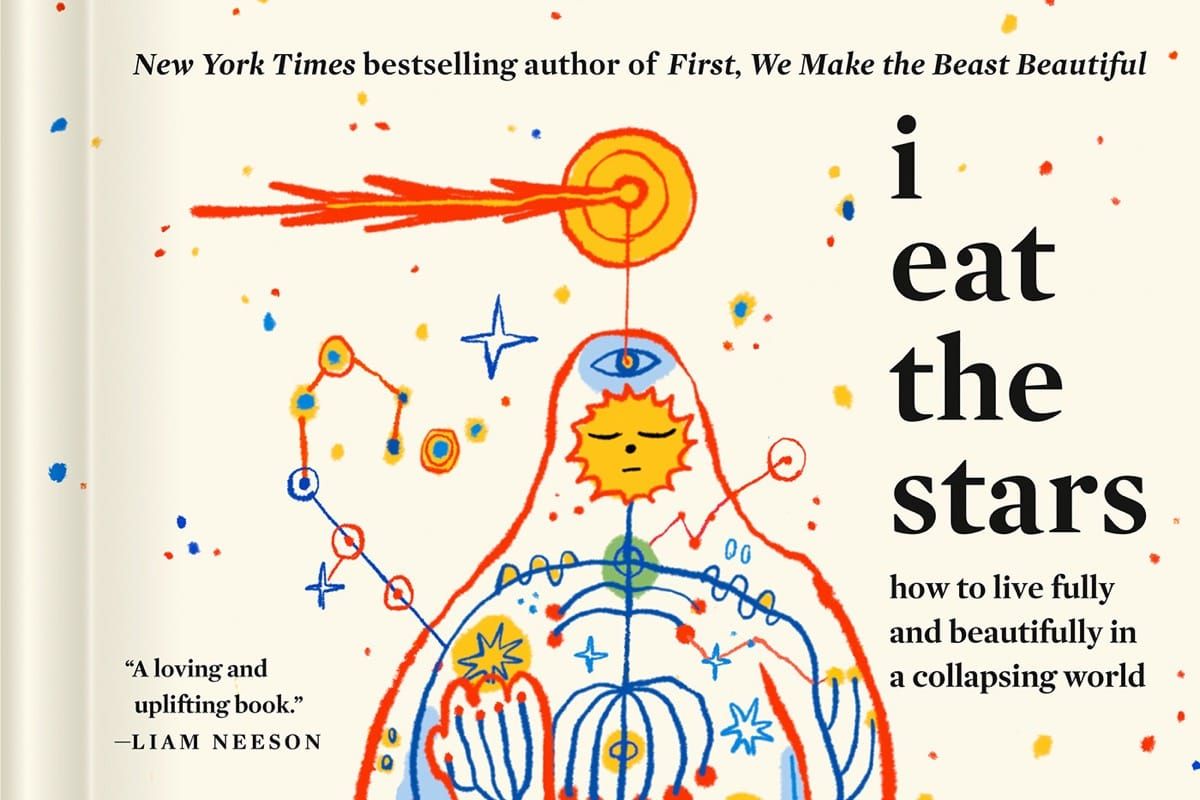
"Humans, I sense, just don't have the capacity for so much foresight," (p.1) writes Sarah Wilson in I Eat the Stars. That lack of foresight is why we find ourselves in this pickle. By "pickle," I mean climate collapse. Wilson's debut book, First, We Make the Beast Beautiful helped me find a way out of debilitating anxiety; her latest book took me back there, at least temporarily. It also inspired me to start The Livelihood, an idea that had been percolating for some time. In short, we can no longer do anything to avert man-made climate change, so we have to start doing things differently. Very differently.
Our current efforts simply aren't working. For instance, schemes to offset emissions by planting trees are frequently abused. Oh, and the wildfires caused by climate change are destroying these forests and releasing the stored carbon right back into the atmosphere. Since 2001, "Canada's carbon offset forests have been a net emitter." (p.4) Rather than reduce our consumption, it's been business as usual but with more virtue signalling. We've certainly accelerated the move to solar and wind energy, but the infrastructure itself demands precious resources: "we literally can't afford the fossil fuels to make the requisite clean energy transition happen in time". (p. 39) Governments make the right noises, desperately hoping that scientists will find a solution, while cutting research funding and greenlighting giant data centres.
Wilson describes collapse as "an undoing of all the complexifying we've been doing, a coming down the other side of the proverbial bell curve, resulting in fewer people, less convenience, less comfort, failing institutions, and so on." (p.34) You don't need to look too hard too see this already. It costs £500,000 for a studio flat in an unfashionable part of London, but public toilets are rarer than comets. This is not what a civilised society looks like. Systems get more complex, more greedy, and more shit.
As Geoffrey West argues in Scale, complex systems have high metabolic rates, gobbling up a disproportionate amount of resources. Complexity also means fragility. When that system fails, there's nothing left in the tank to repair it. Governments are desperate to keep the AI hamster wheel spinning, not because it's useful, but because its inevitable collapse will spark another recession. We haven't yet recovered from the last recession in 2008, unless you seriously believe NFTs and shitcoins are signs of economic recovery. Governments, Wilson points out, "think of climate change, inflation, and the funding of endless wars as problems that can be solved with...more money, more technological investment, and... growth. Which is like a football team that only counts the goals it scores and not the goals it loses." (p.163) Every failed solution or own goal uses up more fossil fuels.
Other institutions, such as the media, the church, and academia, haven't got a grip on the crisis, either. They're peddling the same messages and our trust has been eroded. Wilson concludes that we now have to find that trust among ourselves and start making sense of the mess. Unlike many other books on the climate crisis, Wilson's book does actually recommend ways that we can act individually and collectively. This is where the book becomes less of a slap in the face and more of a kick up the bum.
One of the book's strengths are the contributions from Wilson's Substack community. This comment helped me realise that this is a beginning, not just an end:
@KristyH: Does anyone else feel that by accepting collapse is happening and inevitable and losing hope that "they" will fix it, actually feels like permission to buck the systems that aren't working or aren't good for us? To stop conforming maybe or just feeling more of a sense of urgency to do things differently? (p. 12)
Much of the prevailing rhetoric is about how we can maintain our existing consumption levels. And some politicians are enjoying success on a platform of taking us back to the 1950s, as though that's the natural state from which we've deviated. Homeostasis says that healthy systems should return to their original state after a change. But we're not in a healthy system. In contrast, Wilson writes, in allostasis, " healthy systems also crave stability after a change, but the baseline of that stability can be somewhere new". Instead of going from X to Y to X, we go from X to Y to Z. (p.148) Wilson describes this as "dancing with life as it's happening". I love the visual image, but fear that not everyone has the energy to dance. Homestasis will look far more attractive to someone whose home is disappearing below sea level or whose body can't cope when it's hotter than Hades.
For those of us who do have the privilege to do things differently, here are some of the actions Wilson suggests we take:
- Address inequality and polarisation wherever and whenever we see it.
- Build trust all around us.
- Refuse to play into algorithms that send us into silos.
- Speak up for others.
- Normalise noble values.
- Rolemodel better behaviour. (p. 41)
Admittedly, many of these actions are tough to define and embody. One of my aims in The Livelihood is to consider how we might move closer to them.
A crisis provides the opportunity to act differently, to become the person we'd imagined. Wilson asked her community about the benefits of climate collapse. One response stood out to me:
@Kirsten: I really want the "me" in my LinkedIn profile to die (p. 77)
Instead of communicating through inauthentic online avatars, we can actually have real conversations and leave the grubbiness of LinkedIn behind. Or we can pursue an Ayn Randian vision where we're competing amid the ruins for dubious prizes and blaming minorities for what's gone wrong. Wilson quotes Dr. Richard Eckersley, who posed this question to respondents in a study: "Given what you know about the state of the world and your own financial situation, is it absolutely your highest priority to become twice as wealthy in the next twenty years and consume twice as much?" (p. 176) But that's what governments are obsessed with. Do we really want to recapture the greed and shoulderpads of the 1980s, or are we ready to do something different?
Swedish systems thinker Nora Bateson invites us to consider: "Who will I be in this dynamic for others?" (p. 45) Depending on our circumstances or privilege, answers will vary enormously. Some people will be genuinely helpless, lacking the capacity to absorb any more responsibilities or the freedom to challenge power. For me, this question provoked a lot of ideas, some of which are now emerging in The Livelihood.
I was especially roused by this paragraph:
"Throughout history, mature women, finally freed of childraising responsibilities and many of the constrictions society has placed on them, have played important roles in steering communities and in fighting for justice. Margaret Mead called it postmenopausal zest. As our estrogen drops off, we have a whole lot less fucks to give about the wrong things (like what people think of us when we speak up). But since our care muscle is so activated from decades of (over)use, we find ourselves with a surprising amount of clear, targeted fucks to give about the right things." (p. 242)
Although the same age as Wilson, I'm yet to experience the "zest". However, I definitely have a "whole lot less fucks to give about the wrong things". I'm ready to launch a few targeted fucks. After I've had a lie down.
I found this book deepling unsettling and often disturbing. I can't say I enjoyed the ensuing sleepness nights, but it was certainly clarifying. Wilson's predictions might turn out to be exaggerated or woefully conservative. Fortunately, we have no idea what's going to happen. Either way, though, we have to live and work differently: because we want to adapt more gradually to the inevitable, or because we have no choice:
"The old world-the material, modernist, fossil-fueled postindustrial complex-began to feel increasingly redundant and sad. And the need for certainty felt like a trap. Things like buying investment properties and creating nest eggs began to feel nonsensical when I could no longer plot where I'd be in five or ten years and when there was no longer a solid map onto which to plot them." (p. 49)
Some people want to ignore what's happening, for perfectly understandable reasons. Others are optimists, believing that human ingenuity will solve the problem that human stupidity created. As Wilson puts it: "What made the Thing, can no longer deal with the Thing, and only serves to make more of the Thing that is in fact destroying the (every)Thing. (p. 94) While hope is seductive, "truth emerges as a far more solid and enlivening thing to peg a life to." (p. 15) People are also more solid and enlivening than social media, expensive gadgets, and ultra-processed food. Paraphrasing Erich Fromm's The Art of Loving, Wilson writes "we often confuse belonging with conforming to a herd, which tragically only ever works to separate us, not connect us." (p. 265) Studies show that acts of kindness and prosocial cooperation promote "moral elevation," making us more inclined to be kind. (p.195) God knows we need some kindness now.
The book's title is a line from the poem 'Antidotes to Fear of Death' by astronomer Rebecca Elson, who died aged 39 from non-Hodgkin's lymphoma. She wrote it while confronting her terminal diagnosis. We need Elson's courage and dignity to face what's coming.